


ABOUT OUR PROGRAM
Applied AI Systems & Product (AIP) is a 400-hour, build-to-deploy program that trains students to design, integrate, and ship real AI features. Learners progress from Python/data fluency and “just-enough” math to classical ML and deep learning, then focus on LLMs, retrieval (RAG), tool use/agents, and building production-ready APIs and data pipelines.
The curriculum embeds MLOps, continuous evaluation, monitoring, and safety/guardrails so models stay reliable, cost-aware, and compliant in real environments. A capstone culminates in a working product with an API, eval suite, dashboards, and a model card/runbook—preparing graduates to contribute immediately as AI/LLM application or systems engineers.
BUILD AND SHIP REAL AI
Train for Roles as an AI/LLM Application or Systems Engineer
Start your journey toward a career building production AI.
Where Graduates Work
Graduates are prepared to contribute immediately as AI/LLM application or systems engineers. Every module ties to a working product, so you leave with a portfolio-ready capstone, not just theory.
PYTHON, DATA & MATH FOUNDATIONS
Python for AI, SQL and data literacy, statistics and experiment design, and linear algebra for ML.
AIP-200 – AIP-204
MACHINE & DEEP LEARNING
Classical ML with scikit-learn, deep learning with PyTorch, and multimodal vision and audio.
AIP-205, AIP-206, AIP-215
LLMS, RETRIEVAL & AGENTS
Transformers, prompt engineering and evaluation, RAG and vector databases, and tool use and agents.
AIP-207 – AIP-210
PRODUCTION AI & MLOPS
AI APIs, data pipelines, CI/CD and model registry, and monitoring, evaluation, and safety controls.
AIP-211 – AIP-214
PRODUCT, USE CASES & GOVERNANCE
Industry solution patterns, product design for AI features, and legal, privacy, security, and risk.
AIP-216 – AIP-218
CAPSTONE STUDIO
Design, integrate, and deploy a complete AI product with an eval suite and operations plan.
AIP-219
Program Curriculum
20 courses · 400 clock hours · Select a course to see what you'll learn.
AIP-200 Orientation to Applied AI & Career Paths 4 hrs
This kickoff frames the program’s build-to-deploy philosophy, the roles graduates target (AI engineer, data/ML engineer, LLM apps engineer), and how you’ll be evaluated. Students review the tooling stack, collaboration norms, and the capstone deliverables so every subsequent module ties to a working product.
AIP-201 Python for AI: Computational Thinking & Scripting 50 hrs
Students solidify Python fluency for AI work—functions, classes, typing, virtual environments, packaging, and testing—while building small utilities and notebooks. They practice data wrangling with pandas and NumPy, write clean, reproducible code, and develop habits like linting, docstrings, and simple benchmarks to support later ML/DL modules.
AIP-202 Data Literacy & SQL for Analytics 20 hrs
This course develops the ability to interrogate data sources with SQL and join results to Python workflows. Learners model schemas, write performant queries, handle messy data, and produce analysis artifacts that stand up to review, forming the foundation for features, labels, and evaluations downstream.
AIP-203 Probability, Statistics & Experiment Design 20 hrs
Students learn the “just enough” statistics needed to build trustworthy models: distributions, sampling, confidence intervals, hypothesis tests, power, and A/B design. Emphasis is on avoiding leakage, reading uncertainty, and selecting metrics so future experiments and offline/online evals are meaningful.
AIP-204 Linear Algebra & Optimization for ML 12 hrs
Focusing on intuition over proofs, this module connects vectors, matrices, and gradients to real learning dynamics. Learners see how optimization choices, regularization, and conditioning affect convergence, stability, and generalization, enabling better debugging of ML and DL training.
AIP-205 Classical ML with scikit-learn 28 hrs
Students build baselines with pipelines, cross-validation, and hyperparameter search using models such as linear/logistic regression, trees/ensembles, and clustering. They compare bias/variance tradeoffs, set up feature preprocessing safely, and produce evaluation reports that become reference points for deep learning and LLM approaches.
AIP-206 Deep Learning with PyTorch 28 hrs
This course builds working intuition for tensors, autograd, modules, and training loops. Students implement and train feedforward and convolutional networks, handle overfitting with regularization and augmentation, and instrument runs with checkpoints and learning-rate schedules to prepare for transformer work.
AIP-207 NLP & LLM Fundamentals (Transformers) 28 hrs
Learners study tokenization, attention, transformer architectures, and the LLM lifecycle. They run inference, parameter-efficient finetuning, and quantization on open models, analyze context windows and cost/latency tradeoffs, and document behavior with task-appropriate metrics to ground later retrieval and agent designs.
AIP-208 Prompt Engineering & Evaluation Methods 12 hrs
Students design robust prompts and prompt chains, then pair them with task-specific evals instead of ad-hoc judgment. They create test sets, define rubrics, measure regressions, and use lightweight guardrails so prompts can evolve safely as products change.
AIP-209 Retrieval Systems & Vector Databases 24 hrs
This module teaches document chunking, embeddings, indexing, and retrieval strategies for RAG. Students compare vector stores, tune recall/precision with re-ranking, manage freshness and provenance, and build small retrieval services that measurably improve LLM answers on proprietary content.
AIP-210 Tool Use, Function Calling & Agents 22 hrs
Students connect models to tools—function calling, structured outputs, and orchestration patterns—to execute multi-step tasks. They design agent loops with grounding, constraints, and timeouts, and evaluate success with task completion, cost, and reliability metrics appropriate for production.
AIP-211 Building AI APIs (FastAPI/Flask) 18 hrs
Learners wrap models and pipelines behind HTTP endpoints with authentication, request validation, and rate limiting. They handle streaming responses, batching, and caching, write integration tests, and publish documentation so other services and front-ends can consume AI features reliably.
AIP-212 Data Engineering for AI Pipelines (ETL/Batch/Stream) 18 hrs
This course covers ingestion and transformation patterns, idempotent jobs, backfills, and schema evolution for AI data flows. Students build small ETL/ELT DAGs, manage metadata, and design datasets that support training, retrieval, and continuous evaluation without breaking downstream consumers.
AIP-213 MLOps: Experiment Tracking, CI/CD & Model Registry 22 hrs
Students track experiments and artifacts, register versions, and automate packaging and deployment with CI/CD. They implement promotion criteria and rollbacks, enabling safe iteration from prototype to staging to production with clear lineage and reproducibility.
AIP-214 Monitoring, Evaluation & Safety Controls 22 hrs
This module treats evaluation as continuous. Learners build dashboards for quality, latency, and cost; write red-team tests for prompt injection, toxicity, and PII leakage; add guardrails and fallbacks; and define SLOs and incident response so AI features remain safe and reliable over time.
AIP-215 Multimodal AI (Vision/Audio) 12 hrs
Students extend beyond text by assembling lightweight vision and audio pipelines—image classification or OCR and speech recognition or transcription—then integrate outputs into LLM flows. They compare modality-specific metrics and understand when multimodal inputs materially improve a product.
AIP-216 Industry Use Cases & Solution Patterns 6 hrs
Through curated case studies, learners map recurring patterns—search and summarization, document automation, analytics copilots, support agents—to the components they’ve learned. They identify pitfalls, cost drivers, and acceptance criteria so solutions align with real business constraints.
AIP-217 Product Design for AI Features (UX, Prompt Flows) 6 hrs
This course connects user needs to system behavior, covering prompt-flow design, affordances for uncertainty, human-in-the-loop review, and success metrics that matter to stakeholders. Students produce lightweight specs and UX flows that de-risk scope before building.
AIP-218 Legal, Privacy, Security & Risk for AI 6 hrs
Learners implement practical governance: data minimization, consent and retention basics, access control, key management, audit trails, and model cards. They run tabletop reviews for threat and compliance scenarios so shipped features satisfy internal policy and customer expectations.
AIP-219 Capstone Studio: Design, Integrate & Deploy 42 hrs
Teams deliver a production-style AI feature: a working API with retrieval or tool use, an eval suite with regression tests, monitoring dashboards, guardrails, a deployment script, a model card, and an incident runbook. The studio simulates real delivery with checkpoints for design review, alpha, beta, and a final demo to stakeholders.
How You'll Learn
INSTRUCTION
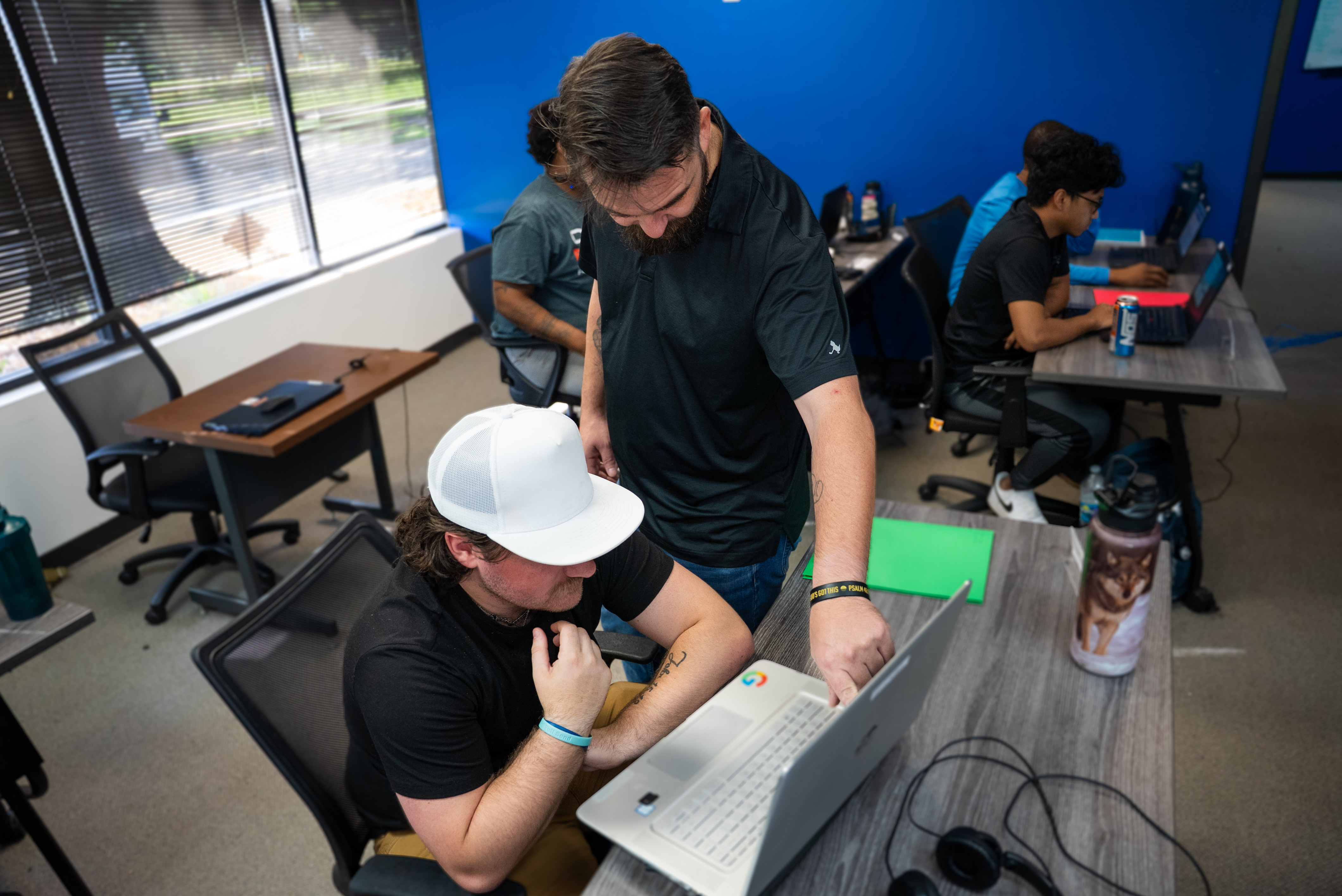
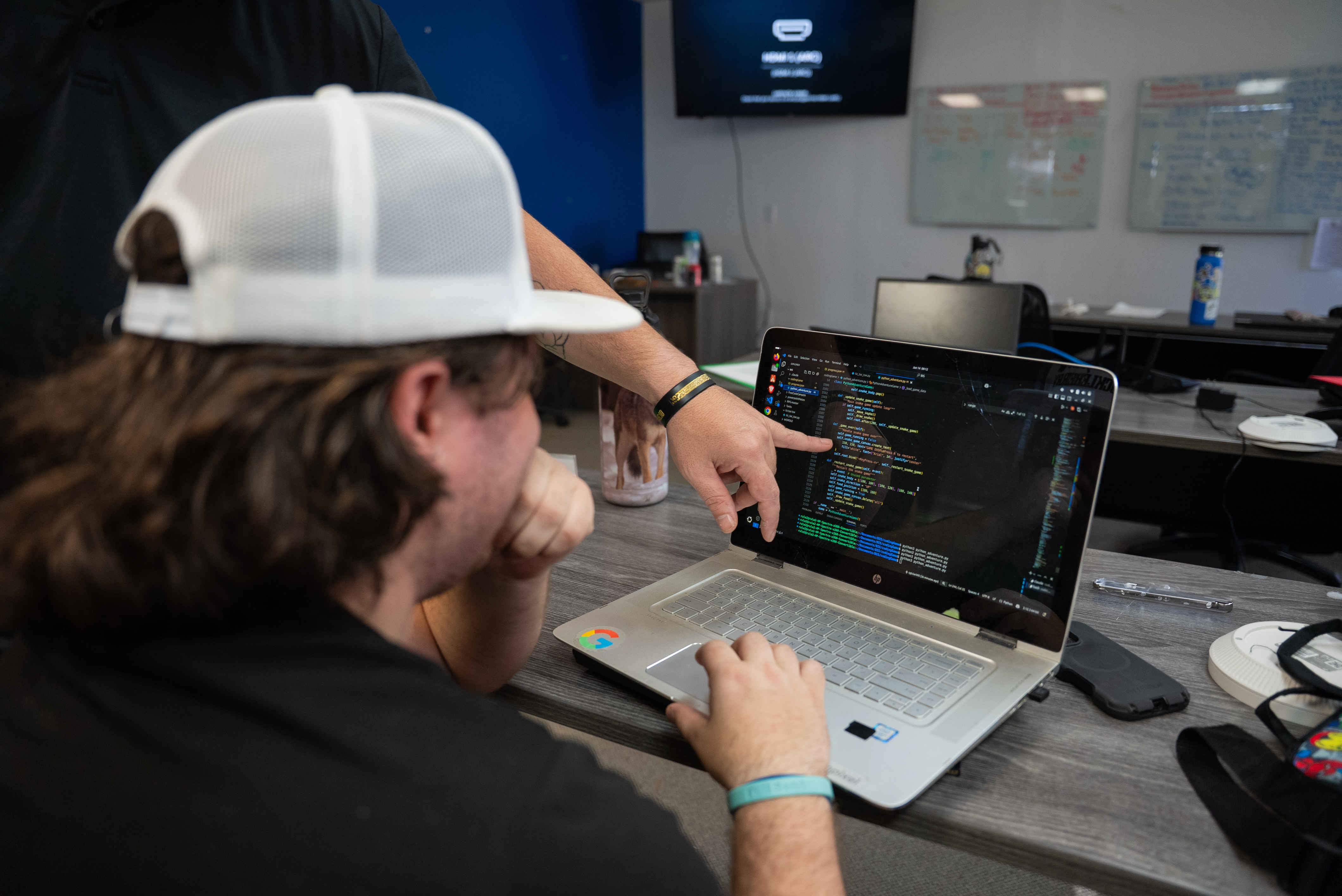
Instruction is delivered through classroom lectures, hands-on coding labs, and applied project work. Classroom lectures introduce foundational concepts in Python programming, statistics and linear algebra, machine learning theory, and transformer/LLM architecture. Hands-on coding labs give students supervised practice building and training models, developing retrieval-augmented generation pipelines, and constructing production APIs using the same tools and cloud compute environments used in industry. Applied project work allows students to integrate models, data pipelines, and monitoring tools into working AI features.
ASSESSMENT
Student learning is evaluated through written examinations, graded coding projects, hands-on lab exercises, and a capstone project. Written exams measure understanding of ML theory, LLM fundamentals, and MLOps concepts. Graded coding projects and lab exercises assess the student's ability to build, evaluate, and deploy AI models and pipelines to professional standards. The program concludes with a capstone studio project in which students design, integrate, and deploy a complete AI product with an evaluation suite and operations plan, demonstrating mastery of the skills required for entry-level AI/LLM application or systems engineer roles.
CAPSTONE · AIP-219 · 42 HRS
Capstone Studio: Design, Integrate & Deploy
Teams deliver a production-style AI feature: a working API with retrieval or tool use, an eval suite with regression tests, monitoring dashboards, guardrails, a deployment script, a model card, and an incident runbook. The studio simulates real delivery with checkpoints for design review, alpha, beta, and a final demo to stakeholders.
LAC vs. Traditional Universities
Compare the Difference
In 400 hours, Applied AI Systems & Product takes you from Python fundamentals to a deployed AI product, so you graduate with the skills, portfolio, and habits employers expect on day one.
Apply Now