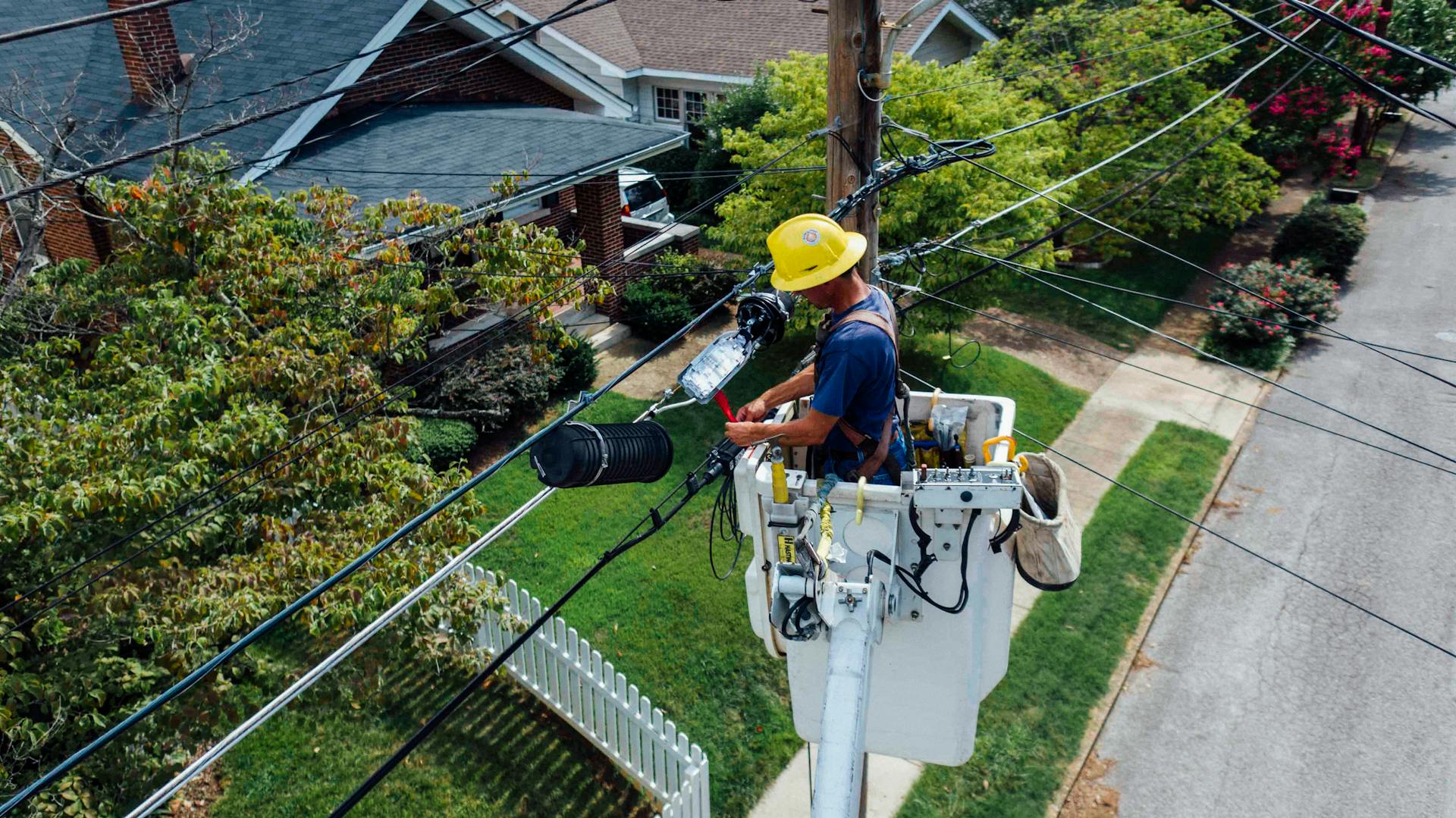
ABOUT OUR PROGRAM
This hands-on program prepares entry-level technicians to build, maintain, and restore overhead and underground electric distribution safely and efficiently. Training starts with right-of-way safety aligned to OSHA 1910.269, traffic control, and First Aid/CPR, then moves into climbing and pole-top rescue, practical rigging, and intensive labs on aerial platforms and digger derricks. Learners connect field tasks to system behavior with power-system fundamentals, then master wood-pole inspection and framing, guys and anchors, overhead hardware and terminations, conductor stringing/sagging, and protective grounding practices.
Underground distribution is covered end-to-end—conduit/duct, vault work, elbows, pad mounts, and switchgear—alongside awareness of stations and live-line boundaries (no energized work). Environmental stewardship, vegetation/ROW coordination, documentation and QC, fault-finding, and storm restoration procedures are woven through the course, so crews deliver safe, compliant work that passes inspection.
A capstone simulates real utility delivery: students brief the job, set traffic control, set and guy a pole, string and sag, install a transformer and secondaries, build an underground segment, verify grounds and device status, and turn in a complete closeout package. Graduates are job-ready contributors who can operate bucket trucks and digger derricks safely, read prints, communicate clearly, and perform core OH/UG tasks under supervision.


POWER THE COMMUNITIES OF TOMORROW
Train for In-Demand Roles in Overhead & Underground Distribution
Start your journey toward a career in electric utility linework.
Where Graduates Work
Graduates are job-ready contributors who can operate bucket trucks and digger derricks safely, read prints, communicate clearly, and perform core overhead and underground tasks under supervision.
They bring the safety mindset, fieldcraft standards, and communication expected by utilities and contractors.
SAFETY, CLIMBING & RESCUE
OSHA 1910.269 right-of-way safety, MUTCD traffic control, First Aid/CPR, climbing, and pole-top rescue.
LER-200 – LER-202
RIGGING & EQUIPMENT OPERATIONS
Rigging physics, material handling, and aerial platform and digger derrick operations.
LER-203 – LER-204
OVERHEAD CONSTRUCTION
Power system fundamentals, wood poles, guys and anchors, hardware and terminations, stringing and sagging, and protective grounding.
LER-205 – LER-210
TRANSFORMERS & UNDERGROUND
Transformers and secondaries, phasing and metering, and underground cable systems and equipment.
LER-211 – LER-212
STATIONS, ENVIRONMENT & STORM RESTORATION
Live-line awareness, vegetation and ROW stewardship, fault-finding, documentation, and storm operations.
LER-213 – LER-215
CAPSTONE: END-TO-END LINE BUILD
A realistic distribution build that integrates overhead and underground work through to handover.
LER-216
Program Curriculum
17 courses · 400 clock hours · Select a course to see what you'll learn.
LER-200 Linework Orientation & Fieldcraft Standards 4 hrs
This kickoff frames the trade, crew roles, and production rhythms of overhead and underground distribution work. Students learn the daily job briefing/tailboard flow, radio etiquette, damage-prevention culture, and how safety, quality, and documentation drive schedule and customer trust. The session also previews skills checks and capstone expectations.
LER-201 Right-of-Way Safety & 1910.269 Essentials 28 hrs
Learners build a safety baseline for linework environments: OSHA/1910.269 fundamentals, hazard recognition, PPE selection, energized equipment awareness, and minimum approach concepts. Workzone traffic control and flagging are practiced to MUTCD guidelines, and First Aid/CPR/AED is taught with right-of-way scenarios. Students write JSAs, rehearse stop-work communication, and coordinate around digger derricks, aerial devices, and other heavy equipment.
LER-202 Climbing Systems & Elevated Rescue Practicum 32 hrs
Students develop confident pole climbing with gaffs, transition to work positioning, and manage tool tethers and dropped-object prevention. They inspect and don harnesses and climbers, climb/descend under supervision, and execute pole-top rescue, lowering and pick-off techniques, and ground-to-aloft coordination. Successful completion is the gate to any at-height work later in the program.
LER-203 Rigging Physics & Material Handling for Line Crews 28 hrs
This module builds practical rigging judgment for everyday line lifts. Learners select and inspect slings, shackles, and blocks; calculate sling angles and working load limits; identify center of gravity; and plan controlled moves with taglines. Rope work and handline systems are drilled alongside equipment staging, load-path control, and exclusion zones so crews move materials efficiently and safely.
LER-204 Aerial Platforms & Digger Derricks Operations Lab 32 hrs
Focused hands-on time with bucket trucks and digger derricks covers pre-trip and functional checks, outrigger setup and cribbing on slope/soft soils, boom inspection, and lower/upper controls including emergency descent. Students practice platform positioning, communication with ground crews, tool/material management aloft, and differences between personnel lifting and material hoisting. Electrical-hazard awareness and rescue integration are reinforced throughout.
LER-205 Power System Fundamentals for Distribution 24 hrs
Learners connect day-to-day tasks to the distribution system they support. Topics include generation to distribution flow, three-phase basics and phasors, neutrals and grounding roles, fault behavior, overcurrent protection concepts, and energization sequences. The goal is intuitive system thinking that informs safe switching boundaries and better troubleshooting.
LER-206 Wood Structures: Inspection, Framing & Setting 28 hrs
Students inspect poles for soundness and class/length suitability, mark framing from prints, and drill/fit arms, braces, steps, and hardware. With the digger derrick they set and tamp poles to line and grade, verify plumb, and secure work areas. Emphasis is on workmanship, corrosion protection, and documentation that satisfies utility standards.
LER-207 Guys, Anchors & Foundations Field Lab 16 hrs
This lab develops competency in guying and anchoring. Learners identify soil conditions, install screw/expanding anchors, attach and tension guys with correct insulators, and verify clearances and guy loads. They complete calculations, check hardware condition, and record measurements to keep structures within design limits.
LER-208 Overhead Hardware & Terminations: Insulators, Ties & Connectors 16 hrs
Students handle, install, and inspect pin/post/line insulators and related hardware, apply correct ties for conductor type and position, and make reliable connectors, sleeves, and dead-ends. They control bend radii, prevent abrasion and corrosion, and leave tidy, labeled work ready for inspection and energization.
LER-209 Conductor Work: Stringing, Sagging & Tension Control 28 hrs
Learners plan and execute conductor handling end-to-end: stringing with travelers, grips, and tensioners; mid-span splicing; clipping in; and final tie-in. They compute target sag from charts with temperature corrections, measure tension, and correct for span and terrain. The focus is smooth, damage-free pulls and accurate final geometry.
LER-210 Protective Grounding & Overcurrent Devices 12 hrs
This course standardizes de-energized work practices: equipotential grounding, bonding jumpers, and verification steps that make work zones safe. Students identify and operate line protective devices at an awareness level—cutouts, reclosers, fuses, and sectionalizers—and document grounds and device status clearly for switching coordination.
LER-211 Transformers & Secondaries: Phasing, Banking & Metering 32 hrs
Students connect single-phase transformers, verify polarity, and phase correctly using sticks and meters; then assemble common banks (including open-delta) and set secondary services. They install and check CT/PT metering components and meter bases, balance loads, and prevent back feed and mis-phasing incidents. Clean labeling and test records round out the build.
LER-212 Underground Distribution: Cable Systems & Equipment 32 hrs
This block covers UG planning and installation: conduit/duct, pulling cable with approved lubricants and tensions, racking in vaults, and elbow installations with proper cable prep. Learners terminate at padmount transformers and switchgear, bond concentric neutrals, and perform basic insulation/continuity checks. Confined-space awareness and water management are reinforced for vault and manhole work.
LER-213 Stations & Live-Line Awareness 12 hrs
At an awareness level, students learn the layout and function of substations, switching orders, and clearance boundaries. They inspect and care for insulating equipment and live-line tools (without energized practice), internalize MAD concepts, and understand when to escalate to qualified personnel. The emphasis is safe proximity and disciplined communication.
LER-214 Environmental Readiness, Vegetation & ROW Stewardship 12 hrs
Learners integrate erosion and sediment controls, spill prevention and response, and waste handling into daily operations. They coordinate vegetation work and clearances, protect habitats and cultural resources, and manage landowner interactions and permit conditions. Field records and photos demonstrate compliance and reduce rework.
LER-215 Documentation, Fault-Finding & Storm Operations 28 hrs
Students practice end-to-end documentation—redlines, as-builts, photos, and QC checklists—alongside systematic troubleshooting for common OH/UG faults (loose connections, damaged conductors, incorrect phasing, bad terminations, grounding errors). They drill storm roles using ICS concepts: damage assessment, hazard tagging, make-safe priorities, crew packs, and rapid communications that shorten restoration time.
LER-216 Capstone: End-to-End Line Build, Test & Handover 36 hrs
Teams plan and execute a realistic distribution build that integrates overhead and underground tasks. They conduct the job briefing, set traffic control, set and frame a pole, install and guy, string and sag conductors, set and connect a transformer with secondaries, construct an UG segment with terminations, verify grounds and device status, and present a clean handover package. Performance is graded on safety, quality, documentation, teamwork, and schedule discipline—mirroring utility expectations.
How You'll Learn
PROGRAM OBJECTIVE
The Line Erector program prepares entry-level technicians to safely build, maintain, and restore overhead (OH) and underground (UG) electric distribution to utility standards. Graduates will demonstrate OSHA 1910.269–aligned work practices, MUTCD traffic control, and First Aid/CPR readiness; execute disciplined job brief/tailboard, stop-work, and documentation habits; and operate aerial platforms and digger derricks responsibly. They will climb confidently and perform pole-top rescue; apply practical rigging and material handling; inspect, frame, set, and guy wood structures; install overhead hardware and terminations; string and sag conductors to specification; and apply protective grounding with awareness of overcurrent devices.
Learners will set and connect transformers and secondaries with correct phasing/banking/metering; construct UG systems end-to-end (conduit/duct, vault work, elbows, pad mounts, switchgear) with proper cable prep and terminations; and maintain station/live-line awareness (no energized work). Environmental and vegetation/ROW stewardship, systematic fault-finding, and storm restoration procedures (ICS concepts) are reinforced throughout. A capstone simulates real utility delivery—from job briefing and traffic control through setting/guying, stringing/sagging, transformer/secondary work, UG construction, verification of grounds/device status, and a clean, inspection-ready closeout—so graduates can contribute on day one under supervision with the safety mindset, fieldcraft standards, and communication expected by utilities and contractors.
CAPSTONE · LER-216 · 36 HRS
End-to-End Line Build, Test & Handover
Teams plan and execute a realistic distribution build that integrates overhead and underground tasks. They conduct the job briefing, set traffic control, set and frame a pole, install and guy, string and sag conductors, set and connect a transformer with secondaries, construct an UG segment with terminations, verify grounds and device status, and present a clean handover package.
Performance is graded on safety, quality, documentation, teamwork, and schedule discipline—mirroring utility expectations.
LAC vs. Traditional Universities
Compare the Difference
In 400 hours, the Line Erector program takes you from classroom fundamentals through hands-on labs to a final capstone, so you graduate with the skills and habits employers expect on day one.
Apply Now